
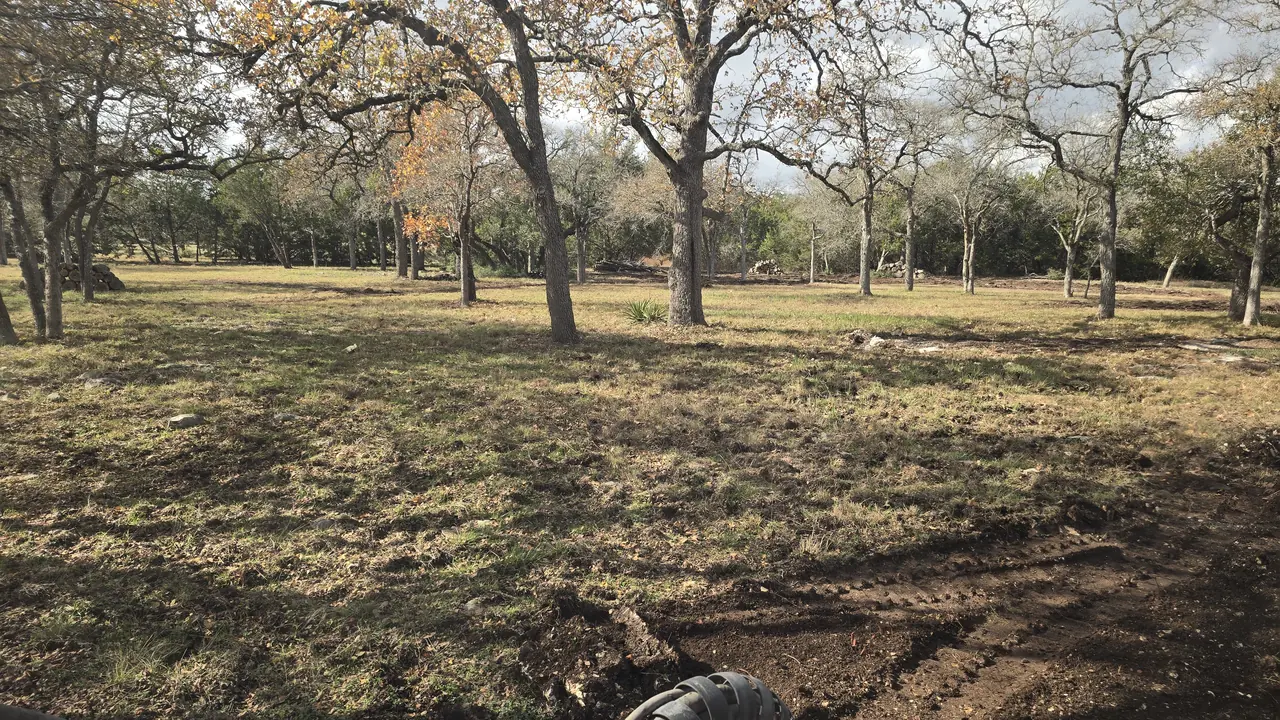
How Much Does Underbrushing Cost Per Acre in Central Texas?
A national cost guide puts light clearing of shrubs, underbrush and small trees at $1,200 to $2,500 an acre. A Central Texas company’s rate sheet puts light brush and underbrush, mulched in place, at $2,000 to $2,800 an acre. A Texas land clearing company’s published figures put light brush and understory at $1,300 to $2,000 an acre. That range holds on a job big enough to spread a machine day across.
Those are market numbers, not our price list. No source we read prices underbrushing as its own job, so each figure is that source’s closest line. Intex Rock and Cedar Solutions does underbrushing around Kyle and across the Hill Country. The work clears cedar (Ashe juniper), brush and small trees from under the trees you keep.
What Do Cost Sources Say Underbrush Clearing Costs Per Acre?
The table keeps each range beside what its source says it covers. The rate sheet’s prices were reviewed in September 2026.
| What is priced | Published market range | Kind of source |
|---|---|---|
| Light clearing: shrubs, underbrush and small trees | $1,200 to $2,500 per acre | national cost guide |
| Moderate clearing: thicker underbrush and medium-sized trees | $2,500 to $4,500 per acre | national cost guide |
| Brush removal | $800 to $3,000 per acre | national cost guide |
| Light brush and underbrush, mulched in place | $2,000 to $2,800 per acre | a Central Texas company’s published rate sheet |
| Moderate cedar and mixed brush | $2,800 to $3,900 per acre | the same rate sheet |
| Mobilization, getting the equipment to the site | $725 per job, typical, varies with distance | the same rate sheet |
| Light brush and understory, stems under 4 inches | $1,300 to $2,000 per acre, on a job big enough to spread a machine day across | a Texas land clearing company’s published job figures |
| A single acre with a skid steer mulcher | $3,000, where the one day minimum governs | the same Texas company |
Each line is close to underbrushing for its own reason.
- The national light clearing tier names underbrush outright. It takes small trees too, and it does not say which trees stay.
- Brush removal is a single per-acre line in the same guide. Brush is most of what an underbrushing job takes out.
- The rate sheet’s light line is priced for Central Texas. It covers fence lines, thin cedar and small brush mulched in place.
- The Texas company’s understory line covers the growth under taller trees, with stems under 4 inches. It holds only on a job big enough to spread a machine day across.
What Counts as Underbrushing, and What Stays?
An underbrushing job takes the brush, small trees and thickets growing under the trees you keep. The oaks and the trees you choose stay standing. With the low growth gone, you can see through the trees and get around on foot. Clearing a long strip along a fence is fence line clearing, a job of its own.
Clearing a whole acre, big trees and all, is land clearing. Our land clearing cost guide covers that price. Underbrushing runs on the same mulchers as our forestry mulching. Our forestry mulching cost guide covers what that method costs.
The Texas A and M Forest Service tells homeowners to remove vegetation under trees that serves as ladder fuel. That growth can carry a surface fire up into the tree crowns. Treat underbrushing as one step in the forest service’s wider advice for the ground around a home.
What Moves the Underbrushing Price Per Acre?
These move an underbrushing quote up or down.
- How thick the understory is. Thicker underbrush moves a job from the national guide’s light tier into its moderate tier. The rate sheet names brush density, slope and access as what moves its light line.
- How many trees stay, and how close the work gets to them. Every tree you keep is one more to work around. The national guide says selective clearing, which keeps the features you want, costs more per acre. It saves on debris removal, the same guide says. The Texas A and M Forest Service’s mulching guidance says to flag each plant you want protected.
- Cedar mixed in. On the rate sheet, moderate cedar and mixed brush runs $2,800 to $3,900 an acre. Dense cedar and heavy growth runs $4,000 to $5,200 an acre. When cedar across a whole pasture is the main problem, the job is cedar clearing.
- Surface rock and slope. West of I-35, the ground is thin rocky soil over limestone. The national guide says rocks and boulders hidden under the growth add difficulty and can damage equipment. The forest service says large rocks, excessive slopes or extreme wetness may not suit machine mulching. Loose surface rock can be ground in place with rock milling.
- Gates and access. The national guide says limited access can mean smaller equipment or more trips, which adds labor time. Our skid steer mulcher works tight spots and around trees worth keeping. Our 400 horsepower wheeled mulcher covers acreage.
Why Does a Small Underbrushing Job Cost More Per Acre?
Bringing a machine to the land is a cost of its own. The rate sheet lists mobilization at a typical $725 per job, varying with distance.
Day minimums matter too. The Texas company’s figures put a single acre at $3,000 with a skid steer mulcher. Below the size that spreads a machine day, its one day minimum governs.
The national guide says one acre costs more per acre than five. Once the equipment is on site, it says, contractors can often work more efficiently across larger areas.
Does Leaving the Mulch on the Ground Change the Cost?
Underbrushing grinds the growth into mulch and leaves it on the ground. With the mulch left in place, debris removal drops out of the job. The Texas A and M Forest Service says mulching reduces erosion potential and stabilizes the soil.
If you would rather burn, we can cut the brush and push it into burn piles for you. The county commissioners court may prohibit or restrict outdoor burning in the unincorporated county. A burn ban like that can leave the piles sitting.
Our guide to Hays County burn bans and brush piles covers the rules. Tell us which finish you want, since it changes the work we quote.
When Can Underbrushing Happen Around Oaks?
Underbrushing works close to the trunks of the trees you keep, and around Kyle many of those are oaks. The Texas A and M Forest Service says to avoid any pruning or wounding of oaks from February through June. Sap beetles that carry oak wilt spores are most active then. It also says to paint any oak wound right away, at any time of year.
Inside Kyle, the city code says oak wounds that expose sapwood shall be painted within 30 minutes. Ask the city office what applies to your lot. On land thick with oaks, the February to June window can decide when the work gets done. Bring up timing when we look at the job.
How Do You Get a Real Number for Your Land?
Published ranges get you close. Your price comes from the growth, the trees you keep, the rock and the access on your land.
Intex is based in Kyle and works about 45 miles around it, across the Hill Country and the I-35 corridor. We do residential and commercial work. See how our underbrushing works, then call or text (737) 317-7625 for a free estimate. We look at the land and put the quote in writing.