
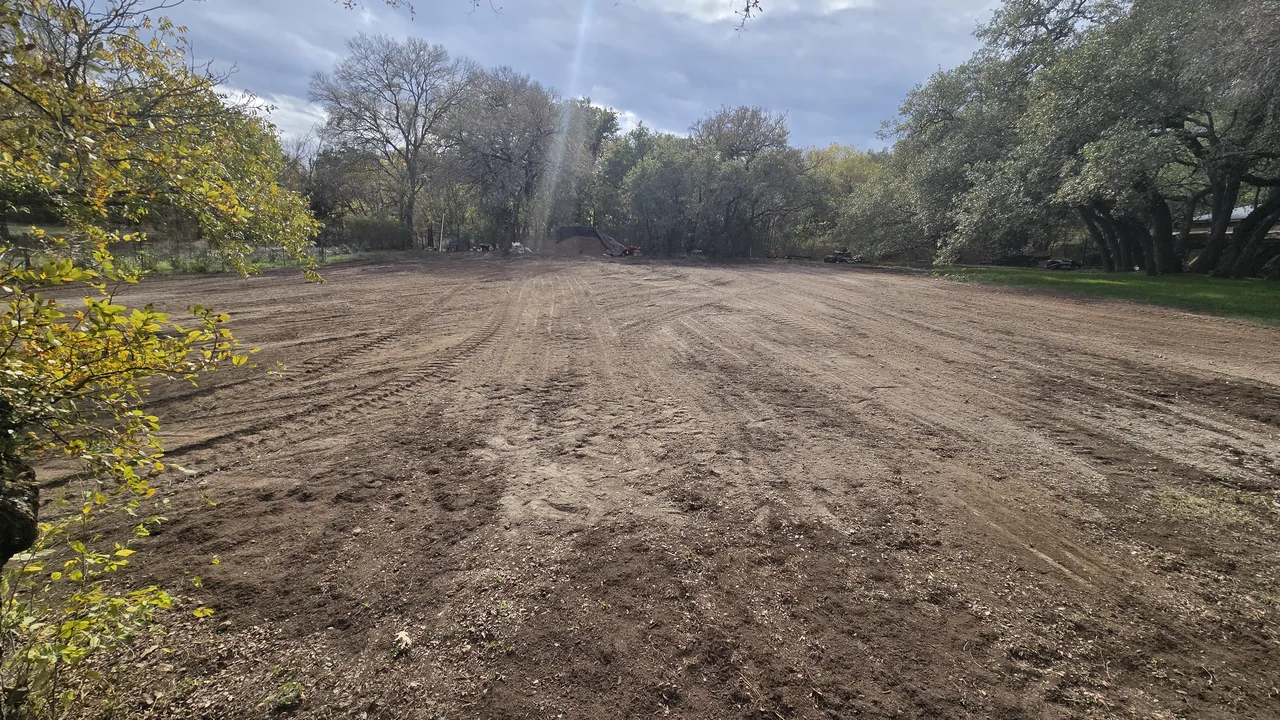
How Much Does Land Clearing Cost per Acre in the Texas Hill Country?
National cost guides put land clearing at about $500 to $2,300 an acre for lightly wooded land. Heavily wooded land runs about $3,300 to $6,200 an acre. One guide lists the average Texas clearing job near $3,850.
In the Hill Country, cedar (Ashe juniper) and rock move your land up or down that spread. These are published market numbers, not our price list. Intex Rock and Cedar Solutions handles land clearing in Kyle and across the Hill Country. Every job gets a written quote.
What do cost guides say land clearing costs per acre?
We read three national cost guides updated between December 2025 and October 2026. We also read the 2026 Texas custom rate survey from the Texas A and M AgriLife Extension Service. That survey asks Texas farm and ranch providers and users what custom work costs. Its rates include labor and fuel.
| What is priced | Published range | Kind of source |
|---|---|---|
| Lightly wooded land | $500 to $2,333 per acre | National cost guides, 2025 to 2026 |
| Heavily wooded land | $3,300 to $6,155 per acre | National cost guides, 2025 to 2026 |
| Brush only | $20 to $630 per acre | National cost guides |
| Forestry mulching, typical jobs | $400 to $600 per acre | National cost guides |
| Grubbing, about 40 small trees and shrubs per acre | $100 to $250 per acre | Texas A and M AgriLife Extension survey, 2026 |
| Bulldozer land clearing | $50 to $300 per hour | Texas A and M AgriLife Extension survey, 2026 |
| Stump removal | $100 to $350 per stump | National cost guides |
| Grading and leveling | $800 to $4,000 per job | National cost guides |
| Permits, where required | $200 to $2,500 | National cost guides |
Hourly rates explain the wide spread. The Texas survey’s bulldozer averages run $144 to $176 an hour. One national guide says clearing an acre can take two to twelve hours. A light acre and a thick cedar acre end up as very different bills.
Why does cedar density move the price so much?
Texas Parks and Wildlife says cedar has become the dominant plant across much of the Edwards Plateau. The Hill Country is the plateau’s deeply eroded eastern part. On a lot of land here, the clearing job is mostly cedar.
Density drives machine time. Scattered cedar on open pasture goes fast. A thick stand of mature cedar takes far more hours per acre. A Texas A and M brush guide says controlling mature cedar takes heavy equipment and is usually very expensive.
Two points from those guides help the math. Cutting Ashe juniper at ground level controls it, and its stumps need no herbicide. The guides also urge landowners to control cedar while it is small.
To put a number on density, use the extension service’s count. Count each small cedar rooted within 3 feet of a 363-foot line, then multiply by 20. That gives cedars per acre. Our cedar clearing work takes the cedar off and leaves the oaks you want.
How do rock and ledge change the cost?
Hill Country land is rocky. The Handbook of Texas describes the Edwards Plateau as thin soil over limestone. One national guide lists rocks among the obstacles that add time to a clearing job.
None of the national guides we read gives a separate per-acre price for rock. Ask for loose rock and ledge to show as their own line on the quote.
Rock has two exits: haul it off or grind it in place. Our tractor-mounted rock mill grinds loose surface rock up to 12 to 14 inches across into 3/4 minus caliche. Boulders and thick ledge get the hydraulic hammer first. With rock milling, the rock stays on site as road base or a pad.
Do slope, access and the trees you keep matter?
Yes. National guides say steep ground and hard access slow machines and raise the cost. Steep draws and narrow gates add hours.
What you keep matters too. Working around oaks you want to save takes more care than clearing everything. We run the 400 horsepower wheeled mulcher on open acreage. The skid steer mulcher works tight spots and the ground around trees worth keeping.
Flag the trees you want kept before we price the job. That way the quote matches the work.
Does mulching in place cost less than burning or hauling?
National guides price forestry mulching below standard clearing on average. The mulcher grinds cedar and brush where they stand, and the mulch stays on the ground. With nothing to pile or haul, debris costs drop.
One guide puts debris removal at $100 to $800 when brush has to leave. The same guide says mulching prices depend on acreage and how thick the growth is. Read how forestry mulching handles Hill Country cedar.
Cut and pile is the other route. We can push cut cedar into burn piles for you to burn. The Texas Commission on Environmental Quality (TCEQ) sets the state’s outdoor burning rules. They let a landowner burn plant growth from land clearing on the property where it grew.
The burn starts no earlier than an hour after sunrise and must end by an hour before sunset. Someone has to watch it. It cannot start when the wind is forecast under 6 or over 23 miles per hour.
A burn ban can stop it. In drought, the county commissioners court can ban or restrict outdoor burning in the unincorporated county. Each order lasts up to 90 days, and a new one can follow. In a dry year, piles can sit for months.
Do you need a permit to clear land in Hays County?
Sometimes. National guides put clearing permits at $200 to $2,500 where they apply. Inside city limits, the city permit office answers that question for your lot.
Parts of Hays County sit on the Edwards Aquifer recharge zone. There, TCEQ rules cover clearing that disturbs the soil. Those rules list clearing vegetation without soil disturbance as outside the regulated activities. The TCEQ’s regional office in Austin covers Hays County, and we point you there before work that moves soil.
How do you get a real number for your land?
Published ranges only get you close. Your price depends on your cedar, your rock, your slope and what you keep. Every job starts with a free estimate and a written quote. Call or text (737) 317-7625, or read how a land clearing job runs with us.