
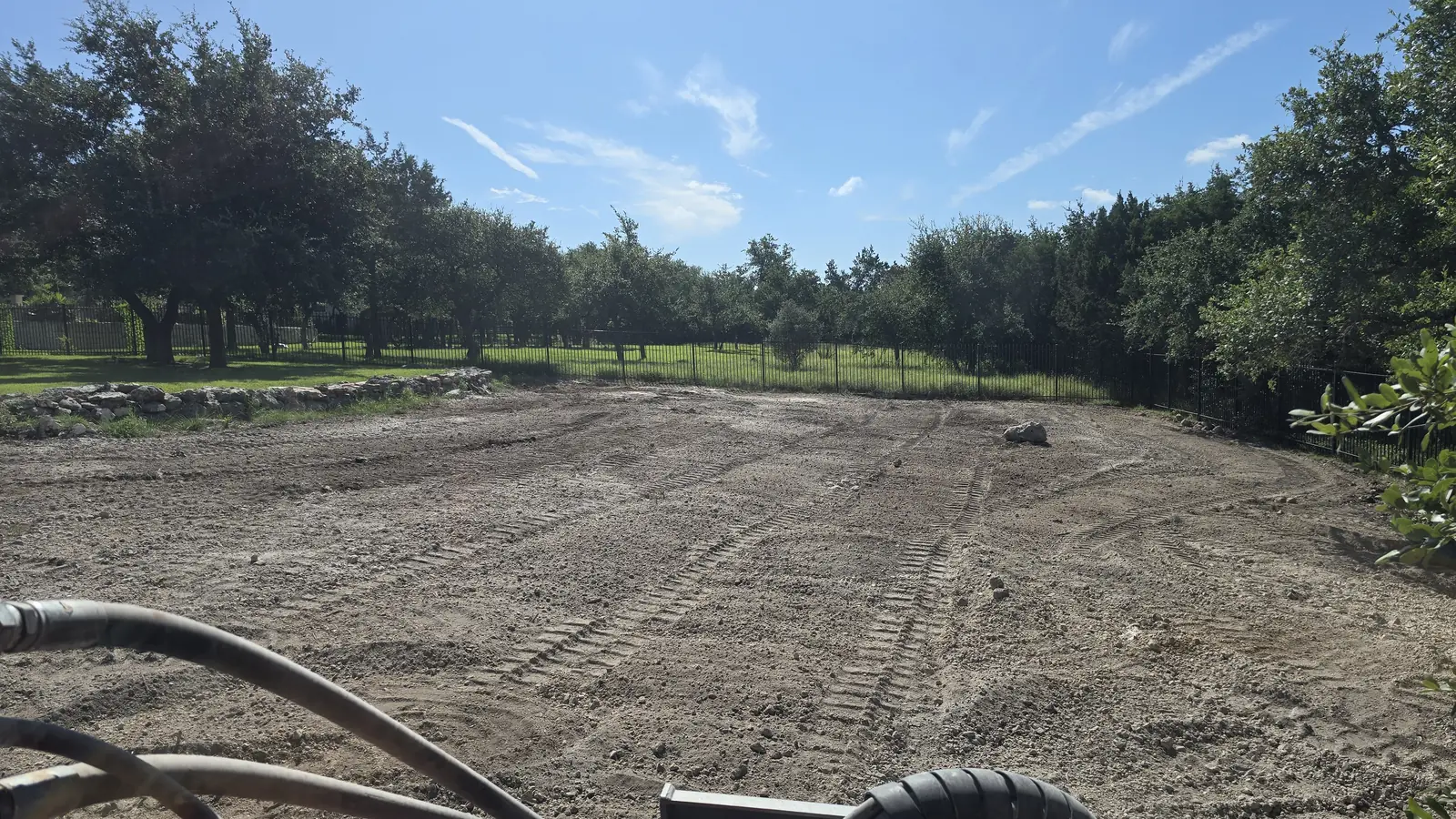
How Much Does It Cost to Level a Yard in Central Texas?
National cost guides put the average cost to level a yard at about $2,175. Most homeowners pay between $1,022 and $3,329. A national cost guide’s Austin page puts the average there at $2,349. Most regrading projects on that page total $1,149 to $3,550.
Those are market numbers, not our price list. A small lawn with shallow dips lands near the low end. Rock and slope push the total up. Intex Rock and Cedar Solutions does land grading around Kyle. The work moves the dirt and rock already on the property to level the ground.
How Much Does Yard Leveling Cost by Size?
Cost guides price a small yard by the square foot and a big one by the acre. The Austin page sits close to the national numbers.
| What is priced | Published market range | Kind of source |
|---|---|---|
| Average yard leveling job | About $2,175 | national cost guide |
| What most homeowners pay | $1,022 to $3,329 | national cost guide |
| Larger or more complex properties | Up to about $6,500 | national cost guide |
| Small to medium areas | $1 to $2 per square foot | national cost guide |
| 1/5 acre | $3,000 to $9,000 | national cost guide |
| 1/2 acre | $8,500 to $22,500 | national cost guide |
| 1 acre | $17,000 to $45,000 | national cost guide |
| Average yard leveling job | About $2,349 | a cost guide’s Austin page |
| Most regrading projects | $1,149 to $3,550 | a cost guide’s Austin page |
| Small to medium areas | $1 to $2 per square foot | a cost guide’s Austin page |
| High end | As high as $5,500 | a cost guide’s Austin page |
A city backyard fits the square foot line. On acreage, the acre rows are the closer guide to the cost to level land, and the total climbs fast. The national guide puts regrading labor at $50 to $100 per hour.
What Drives the Cost to Level a Yard?
Size sets the starting point. After that, these move the yard grading cost most.
- Slope. A yard with a steep drop takes more cut and fill than one with shallow dips.
- Rock. Loose surface rock and ledge slow the work, and big boulders need breaking first.
- Your own dirt or trucked-in fill. Cut and fill with the property’s own dirt and rock means less material to buy. When a yard comes up short, fill and topsoil come from a material supplier. The national guide puts fill dirt at $5 to $30 per cubic yard and topsoil at $12 to $55.
- Clearing first. Cedar (Ashe juniper) and brush come off before grading starts. Our land clearing cost guide covers that part.
- Access. A narrow gate or a fenced backyard limits which machine fits.
- Permits. Where one is required, the national guide puts permits at $100 to $500.
Can Topdressing Fix a Lumpy Lawn Instead?
Shallow dips in a healthy lawn may not need machines. Topdressing spreads topsoil or sand over the grass to fill low or bare spots. One university extension guide says to apply no more than half an inch at a time. A thicker layer can stunt the grass or shade it.
Topdressing is lawn care, work for the owner or a lawn service. Regrading is the machine work we do. It cuts the high spots and fills the low ones with the property’s own dirt and rock. A yard that tilts toward the house or holds standing water usually needs the ground itself reshaped.
How Does Hill Country Rock Change the Price?
Rock is the Hill Country’s extra line item. Texas Parks and Wildlife says the Edwards Plateau formed from marine deposits that include limestone. It calls the eastern part, the Hill Country, deeply eroded.
Loose surface rock can go one of two ways. It can be dug out and hauled off, with fill trucked in to take its place. Or rock milling grinds it in place into 3/4 minus caliche, a base that stays on the property.
The mill handles rocks up to 12 to 14 inches in diameter. Bigger boulders and thick ledge get the hydraulic hammer first. For grass, topsoil goes on top of the milled base. Our guide to rock milling and caliche base covers the process.
What Rules Apply When You Regrade a Yard in Texas?
A regrade touches a few rules, and most are about where the water goes. Check them before the machines start.
Drain water away from the house. The International Residential Code says lots shall be graded to drain surface water away from foundation walls. It says the grade shall fall at least 6 inches within the first 10 feet. Inside a city, the building department says which code applies to your lot.
Keep runoff off the land next door. The Texas Water Code covers this. No one may divert or dam up the natural flow of surface water so its overflow damages another person’s property.
Call 811 first. State law counts grading with powered equipment as excavating once it disturbs soil 16 inches deep or more. Texas 811 says to contact them at least two business days before excavating, not counting weekends and holidays. Public utility companies may not mark lines that run from the meter onto private property.
Big jobs and stormwater. TCEQ, the state’s environmental agency, has a construction stormwater permit for jobs that disturb an acre or more of soil. Most backyard jobs are smaller, but a regrade on acreage can reach that size. TCEQ answers what your job needs.
Over regulated parts of the Edwards Aquifer, some jobs need a TCEQ-approved plan before the soil is disturbed. TCEQ’s map viewer shows whether a lot sits in a regulated zone.
City permits. Inside Kyle city limits, the city says a permit is required before any construction. The city permit office answers whether your grading counts, and we point you there.
When Does a Regrade Need an Engineer or a Surveyor?
Some lots need a plan on paper before any dirt moves. An engineer draws a grading plan with set elevations. A surveyor marks property lines and measures elevations. Your builder or the city can say when a lot needs one.
If water has already damaged a foundation, ask an engineer before anyone grades. When a plan exists, bring it to the estimate so the grading follows it.
How Does Intex Handle Land Grading Around Kyle?
Intex is based in Kyle and works about 45 miles around it, across the Hill Country and the I-35 corridor. We do residential and commercial work.
Our land grading levels backyards and homesites with the dirt and rock already there. Rocky ground gets rock milling first. New driveways and pads fall under site work.
We look at where the water should go and how much rock is in the way. That sets the land grading cost for your lot. Then we give a free estimate and put the quote in writing. Call or text (737) 317-7625.