
What Does Rock Milling Do to Hill Country Limestone?
Rock milling grinds the loose limestone on your land into crushed base, right where it lies. We call the result 3/4 minus caliche. Wet and rolled, it packs into road base for a driveway or a pad. Covered with good topsoil, the same ground can grow a lawn.
That is what rock milling does on a rocky lot. The rock you would otherwise haul off becomes the base you would otherwise buy. The catch is testing. Milled base has no lab report behind it, so a house slab or a county road follows its own spec.
Why is Hill Country ground so rocky?
The Hill Country is limestone country, and the soil over it is thin. One USDA soil survey maps Comal and Hays counties together. About half that land sits in map units named for rock outcrop. The biggest one, Comfort-Rock outcrop complex, covers nearly one acre in five.
Comfort soil is stony clay just 10 to 20 inches deep over hard limestone. Below the surface, rock makes up 35 to 75 percent of the soil by volume. Some pieces run about 2 feet across. The extension office in Travis County says thin soil over rock holds little water and is prone to drought.
What does a rock mill do to the rock?
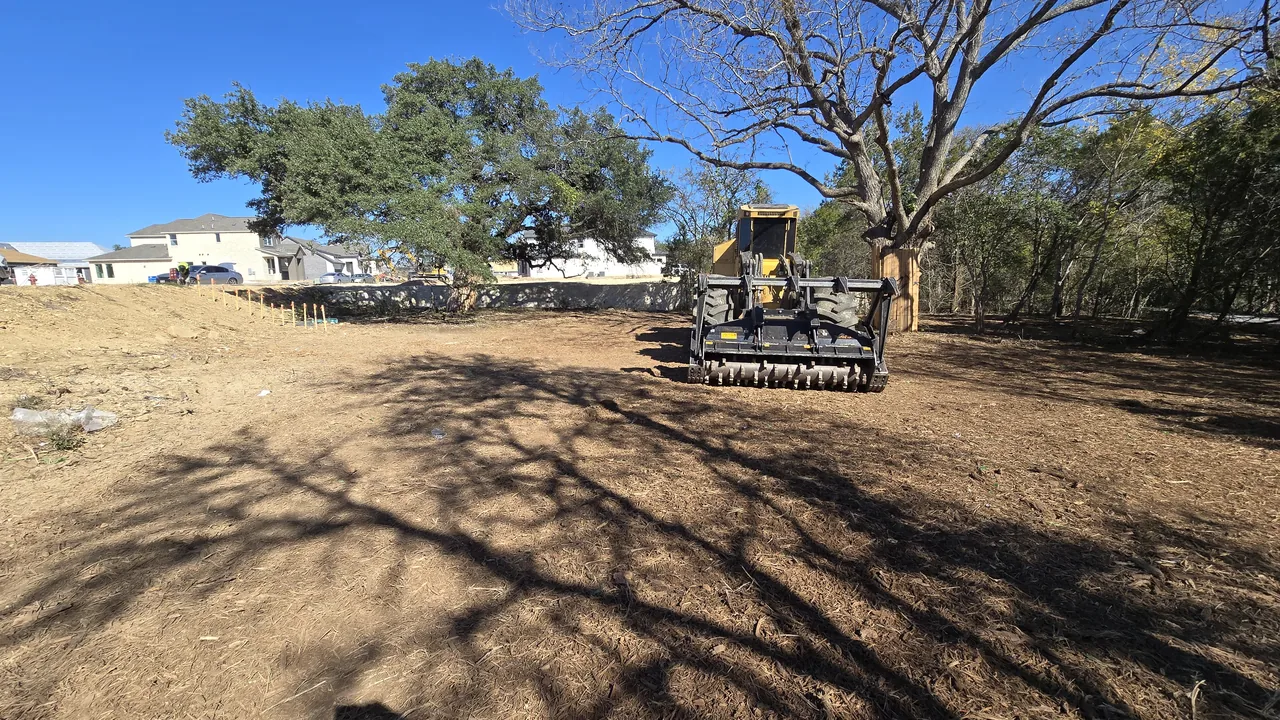
On our jobs, a tractor-mounted mill does the rock milling. It grinds loose rock up to about 12 to 14 inches across. Boulders and thick ledge get broken with a hydraulic hammer first, then go through the mill. A skid steer rock crusher does the same work, and that version is called rock crushing.
The mill grinds the rock where it lies, along with the thin soil around it. What comes out is crushed limestone mixed into the top layer of ground. The rock stays on your land as base instead of riding off in a dump truck.
What does 3/4 minus caliche mean?
The name 3/4 minus means pieces 3/4 inch and smaller, with the fines left in, down to dust. Those fines fill the gaps between the bigger pieces. That is why the layer packs tight when it is wet and rolled.
Caliche is the white soil seen across the drier parts of Texas. The state’s geological survey describes it as soil made mostly of calcium carbonate, the same mineral as limestone. Some caliche is soft, and some is almost as hard as rock. Ground limestone is the same mineral, and the milled mix goes by the same name.
Is milled caliche the same as TxDOT road base?
Road base is what TxDOT calls flexible base, a granular layer laid under the surface with no binder. TxDOT’s base guide says crushed stone such as limestone is the most common rock available in Texas. Its highway spec, Item 247, even lists caliche as its own base type, Type E.
The spec sets hard limits, and each source must pass lab tests before use. In Grade 1 to 2 base, every piece must pass a 2 1/2 inch sieve. Other tests limit how sticky the fine part can be. Milled base, your own rock and soil ground in place, has not been through those tests.
TxDOT’s guide also says local material can cost the least because trucking adds up. It adds that local sources may not match the quality of material from farther away. For a ranch road or a driveway, milled rock often becomes the road base. For a slab or a county road, the plans set the spec, so ask before the work starts.
How does milled rock become a driveway or a pad?
Rock milling is the first pass. Turning milled rock into a driveway takes a few more steps:
- Contact 811 two business days ahead when buried lines may be near.
- Break boulders and ledge with the hammer, then mill the rock along the route.
- Set culverts where the drive crosses a draw or a ditch.
- Grade a crown, higher in the middle, so rain runs off to the sides.
- Wet the base and roll it until it packs hard.
Moisture matters at that last step. TxDOT’s spec has crews compact base within 2 percentage points of its ideal moisture, set by a lab test.
A barn or shop pad is built the same way, just flat instead of long. If a house slab will sit on it, the foundation plans set the pad spec. Culverts and grading fall under our site work for ranch roads and pads.
What does milled ground need before grass?
A lawn wants the opposite of a driveway. A driveway wants packed rock, while grass wants loose, deep soil. The extension office in Travis County calls 6 inches of soil the minimum for lawn grass. Turf on less, it says, stays weak and needs constant watering.
The extension service’s Texas turf guide prefers 10 to 12 inches. Where soil is thin, it says to bring in good topsoil, with loam or sandy loam best.
The same guide says to grade so water drains away from the house. A fall of 6 inches over 40 to 50 feet is enough. Rock milling can end with the ground graded smooth, ready for topsoil and sod.
Does milling cost less than hauling base in or rock out?
The comparison comes down to trucks and material. Each approach puts the money in a different place.
| Approach | What happens to the rock | What you pay for |
|---|---|---|
| Rock milling | Ground into base where it lies | The milling work, quoted after a look at the ground |
| Hauling base in | Stays under the new base or gets bladed aside | Base by the ton or the yard, plus delivery |
| Hauling rock out | Loaded and trucked away | Hauling and disposal, then base or soil to fill in |
National cost guides put crushed limestone at about $25 to $40 a ton, or $30 to $60 a cubic yard. One guide adds about $5 a mile for delivery and notes minimum orders as large as 20 tons. Take a 12-foot driveway with 6 inches of base. It needs about 22 cubic yards per 100 feet, or roughly $670 to $1,330 of stone before delivery.
Hauling rock away runs higher per yard. One national cost guide puts removing and disposing of yard rock at about $220 to $250 per cubic yard. Where milled base does the job, rock milling skips both bills. Its price follows the acreage and how thick the rock lies.
These are market numbers, not our price list. For the full driveway math, see what a gravel or caliche driveway costs in Central Texas.
What is the next step for a rocky lot?
Intex Rock and Cedar Solutions does rock milling and rock crushing across the Hill Country and the I-35 corridor. We are based in Kyle and work about 45 miles around it. If brush and trees cover the rock, start with land clearing in Kyle and the Hill Country.
Our rock milling and rock crushing service covers how a job runs. A free estimate comes first, and the quote comes in writing. Call or text (737) 317-7625.